ah. it writes and i edit it. me and Stanley Duckenmiller. it's a way better writer than i am. so is my cousin who is a golf writer for 30 years. so you're correct. i am excellent at editing though :)
Your parent comment reads like AI slop, so you may not be as good at editing as you think. Worth thinking about the impression you’re conveying about yourself.
Of course, but the users can’t be trusted to stay away from something designed to addict them.
Only real solution is regulation, although the how is still a big question mark.
I would ask, where is the line drawn between 'enjoyment and addiction.'
Is it the harm provided? Then what do we count as harm, and where is the line.
IE, There's no one stopping me from eating unhealthy, IE sugary foods, which are heavily addictive. I ride a motorbike, and I'd consider myself addicted to that, and it's got a high chance of harm, but we don't ban those. Ditto with gaming, social media, hobby XYZ.
I personally think the freedom to choose your vice is reasonable.
Maybe this freedom sounds reasonable at first. Pew Research says 36% of 13–17 year olds are on social media almost constantly [0]. This is not a problem that existed 20 years ago. The ease of access to highly addictive products is rotting the soul of society.
Instagram definitely doesn't have the option but youtube for instance does, there's a subscription tab that's collecting dust in most people's accounts.
Genuine question, did you put work into distribution so people knew about it first?
I've known a bunch of people who have said 'blogging is dead' but that's often shared with a lack of sharing the work in the first place or sharing it.
Health isn't a 'perfect or your unhealthy' it's much more of a 'Make the better option, most of the time' in which, similar to the original comment, I am quite happy that the chocolate I can have a treat with has less calories but feels identical in levels of being a treat.
I'd pay the same for chocolate bars that were half the size if they were easily available.
But if you want to indulge, there's a lot much much nicer quality treats than a mars bar, that's what I meant. That might be better for you but also a lot tastier.
But tastes differ of course. I love sweets and snacks and I eat too many but I never like the American ones so much. We have a shop nearby that sells American sweets but they are all so heavy on the sugar. Chocolates are too sugary, You can't really taste anything else. And things like nerds have this really strong artificial flavour. But that's personal of course and also what I grew up with.
Yeah but SMS is also a paid product in most places, same with phone calls, and data too, but given most places (Schools, your home, work, libraries) pay for wifi, platform provided messaging is free.
Not that the addictive apps are great, but if we're talking locking, it's deciding between 'paying for' and 'receiving for free' with lock in being constant
Reasoning models are the same speed. They’re just post trained with RL to do CoT inside tags like <thinking></thinking> before a tag like <response></response>
There’s no difference in the inference implementation, parameter count, or speed.
There's a difference in the latency distribution between when you submit a query and you see the response, which is what the comment is (clumsily) asking about.
But yeah, there are a lot of factors, so it's hard to answer, and tokens/s isn't the right question.
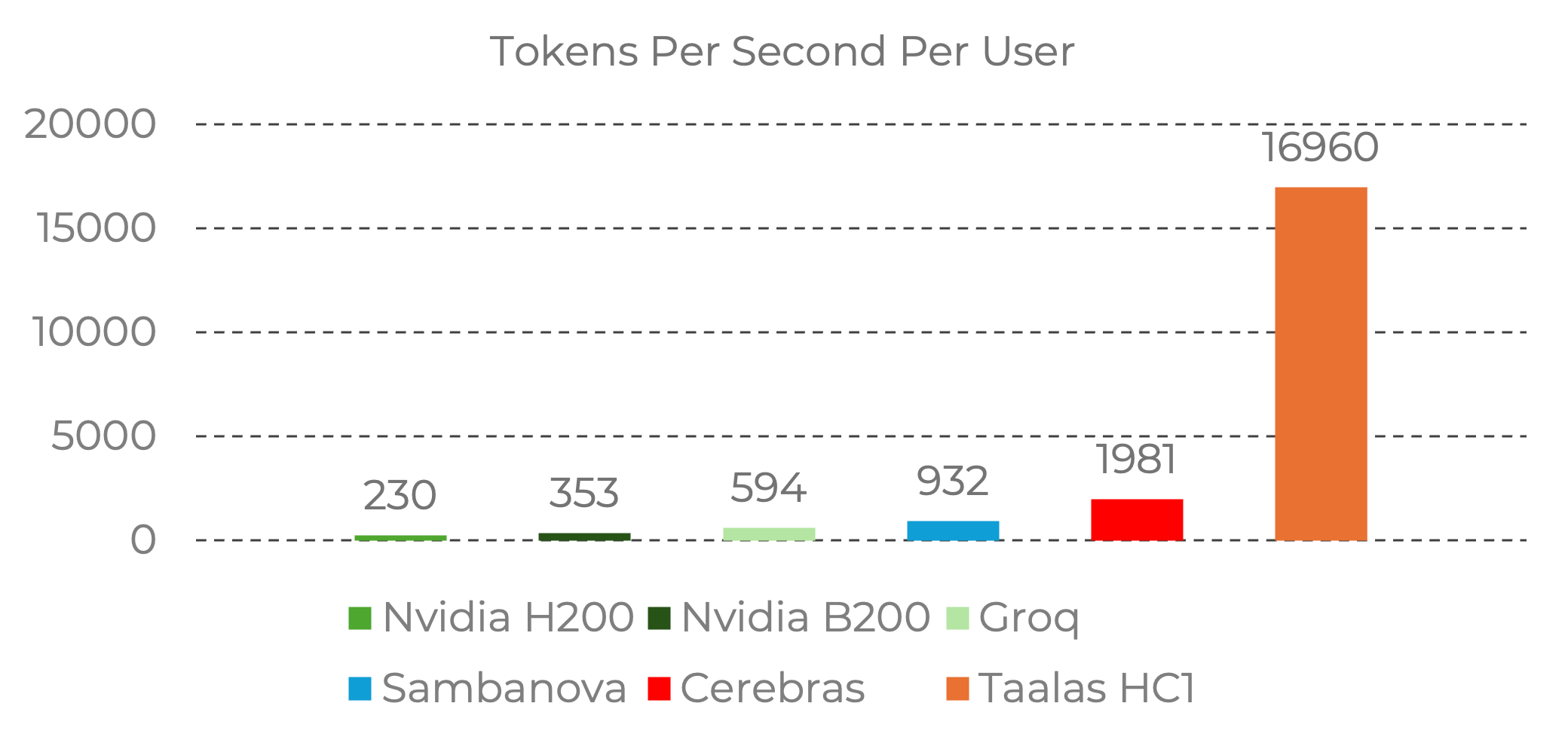
So this demo is around 90 times faster than typical speeds for the same model at openrouter, and around 30 times faster than the absolute fastest option available (Groq).
I feel as if you missed their point. Their point from my understanding is, coal might be more expensive than new renewables/batteries, but it's significantly quicker to get up and running so if you have a choice between quick coal and nothing, coal will be chosen.
I haven't looked into this deep enough, but my assumptions are that currently the supplychain for getting and installing these systems takes much longer than coal, which is a much more mature supply chain, and also not limited to China's production. If solar panels were as cheap, quick and available as coal, there'd be literally zero reason why people wouldn't use them over coal, but we know there are enough places that still use coal IE Germany.
I am not missing the point. You can deploy hundreds of megawatts of solar and batteries providing firm generation in 12-18 months. You cannot build a coal generator that quickly (usually takes 2-5 years). If you can turn on or up an existing coal generator, yes, faster. If you must build it from scratch, no, slower. Solar and batteries are not only the cheapest form of new generation, they are also the fastest to deploy.
* Since the war in Iran began in February 2026, a surge in oil and gas prices has triggered gas-to-coal switching in Southeast Asia, pushing Asia’s coal benchmark nearly 20% above the pre-war price levels and highlighting the links between the coal, gas and oil markets.
* Gas-to-coal switching also pushed coal prices up after the 2022 gas crisis, when Asia’s coal benchmark surged to a record USD 443 per tonne in September 2023.
* Renewables sit apart from the price volatility of coal, oil and gas, as they do not require ongoing fuel inputs. In 2024, solar was already cheaper than coal in 7 of the 10 member countries of the Association of Southeast Asian Nations (ASEAN), according to LCOE data.
* The current gas crisis is already causing a decline in LNG demand across ASEAN countries. New ZCA analysis shows that were ASEAN to replace its planned 45 GW gas expansion with coal, costs would rise; in contrast, we found the Association could save USD 4 billion if gas expansion plans were instead replaced with solar and storage solutions by 2030.
* Even in countries with large coal reserves and coal subsidies, including China, renewables are already meeting a significant share of new electricity demand.
You can deploy solar and batteries rapidly, Australia is doing it.
Australia has the highest number of solar panels per capita in the world. Batteries are following suit with government subsidies. Yet, Australia has some of the highest energy prices in the world, its not a fool proof solution.
My comment wasn't even really about coal, it was about oil (and fuel). I'm talking about transport (even public transport) but planes & massive tankers are the big consumers. The original point is simply we cannot just stop ships.
When ships stopped due to the routes being blocked, we pushed ever closer to a recession and people starved and died because they were denied critical produces, equipment, food and medicines all over the world. Not to mention cost of living. This is what I mean by we "cannot afford" to not use oil.
We cannot afford for the routes to be shut, we cannot ban boats, cars, planes without major economic downturn.
Australia is pretty unique since it’s extremely suitable for solar. Countries in more northern latitudes, especially in Europe (where you need alternative sources in winter regardless of how much solar you (realistically) build) are in a slightly different situation.
Also aren’t wholesale prices in Australia very cheap or often negative? If that’s the case then the issue very high prices isn’t really on the production side but due to taxes/distribution
> Are you against Apple removing apps with dark patterns from the App Store because 'Everyone does it'?
Are you in favor of Apple removing everyone from the App Store?
> Adding requirements for apps to remain on the App Store is fully reasonable, and keens the ecosystem usable for users.
Apple created a developer API to request ratings and reviews. Apple 100% approves of and encourages the practice. Indeed, Apple's own apps in the App Store request ratings and reviews.
> Are you in favor of Apple removing everyone from the App Store?
You make the assumption that it's not in everyone's best economic interest to follow the rules. People will change before they are all removed.
> Apple created a developer API to request ratings and reviews. Apple 100% approves of and encourages the practice. Indeed, Apple's own apps in the App Store request ratings and reviews.
And they added various limitations to this API to prevent bad actors, which clearly is being worked around by enough apps that it makes sense to enforce this more.


reply