Like others who have posted here, I have s story similar to this. By the sounds of it, I wouldn't call myself as "gifted" as some who have posted here but, relative to the environment I was in, I was "gifted".
I grew up in three small towns. For the first 9 years, in a town of less than 1,000 where the 3rd and 4th grades (for example) were in the same class.
When I was 8 I was doing the same work as the 7th graders without any real trouble. It's all this small school could really do for me. This was actually mostly OK. Sure I was largely around (much) older kids but it really wasn't as isolating as some other experiences posted here.
Next was a slightly larger town (5-10,000) for 4 years. In the 4th grade my spelling tested at the 10th grade+ (I ran out of "test"). In the 5th grade I was doing algebra and trigonometry. By the 7th grade I was doing calculus. Honestly, maths was really the only thing that interested me. Until that is my family got a computer we couldn't really afford (a VIC 20), which turned out to be fairly limited (much less so than the C64 that came after it).
I can distinctly remember at age 10 reasoning out that God didn't exist (I was raised Catholic and went to a Catholic primary school with nuns and everything).
It's in this period where I think it became first apparent just how socially well-adjusted I wasn't. I think it's fair to say I didn't particularly know how to relate to others. Honestly, I'm not sure that still isn't true.
By 9 or so I could beat anyone I knew at Chess. Actually I think this was true at 7-8. Not that I knew anyone particularly good (not even remotely). Attempts to find a challenge from, say, chess AIs were pointless. They were pretty weak back then and tended to be defeated by going "off book".
Then came a move to a mining community of ~15-20,000, which I basically hated for the 5 years that constituted high school. The awkwardness and isolation from primary (elementary) school was compounded. It's always seemed to be that when it comes to social interactions and relationships, I somehow "missed out" on the instruction manual, or at least the training wheels, and the people around me were always speaking some language I just never understood.
I understood numbers and computers.
One of the problems was that I was bored. I found school so insanely easy. Nothing was really a challenge. I'd get told how smart I was. Only many years later did I fully appreciate just how much damage it does to be told you're smart. It demotivates you and isolates you.
I would fail assignments and classes because I didn't do them. Not because I couldn't do something but something was never good enough. Or I'd fear the embarrassment and "humiliation" of not knowing something and having that pointed out to me.
I can remember having conversations with my parents where I'd bring home a 90% in a test and I'd get asked "what about the other 10%?" I don't think this was asked in a way to be mean. In a strange way, I think it was a weird way of showing pride because all you can "complain" about is a missing 10%. Whatever the case and in spite of well-meaning intentions, the message that was hammered in was that nothing ever seemed good enough.
My father was a fitter and turner in the British merchant navy. His father and grandfather were likewise tradesmen. My mother dropped out of high school (although her father was a school teacher and principal for much of his life).
Basically I don't think they knew what to do with me. Academic pursuits weren't something they were equipped to deal with. My two sisters were cut from the same cloth, neither being remotely academic and neither finishing high school.
I took notes in class but never looked at them again. Either I didn't need to (particularly for maths) or I didn't care to (eg human biology). I never really learned how to study. I can remember scoring 85% in multiple choice exams for subjects I knew nothing about just by figuring out the skills to pass such exams.
So after finally finishing high school I went to university.
It may sound strange but I don't think it ever occurred to me in high school that I might do computer programming for a living. It's not like thought about it and either wanted to or didn't. I never even pondered the question.
I ended up applying to do a science/engineering double degree because it looked hard. A bunch of other people in my class also ended up applying for engineering because they didn't know what to do either but, as I learned years later, I seemed (to them) to know what I was doing. I have to wonder what they would've become had I gone to school elsewhere.
Whereas high school was structured, university was not. Nobody checked your attendance. Painful shyness quickly caused me to avoid going to lectures altogether. I was completely unequipped for university.
I barely skated through first year and bombed out in second year (when you actually had to work). Some years later, work finally cured me of many of the aspects of painful shyness (eg standing up in front of people and giving presentations).
At one point my parents thought to send me to boarding school (in a 1 million+ city). I fought this and deeply regret it. It was an unknown. I wonder how much better I could've done if I'd been put in an environment where academic excellence wasn't a recipe for instantly being ostracized (as it was in my shitty state high school).
Likewise I wish I'd stuck with university long enough to find some guidance and mentoring. All in all it feels like I drifted through the system and eventually fell through the cracks.
At no point did I ever really find people like me either. Through primary and high school, the towns seemed too small for that. The university had a computer club but I found that lot, as a whole, to be a pretentious lot with whom I had precious little in common. It seemed like university just had a different cookie-cutter mold for the "in" group.
Largely I was left alone (something I realize I quite clearly contributed to). To me though that seemed to be an improvement from high school so I just went with it.
Now my sisters both have children and I see them both laud their children by telling them "you're so smart". I try to tell them how damaging this is and they shouldn't but they just don't get it. Old habits kick in.
I envy those people who grew up in households where at least one parent had gotten a college degree (a friend I later made had a PhD in lithography stuff, 3 members of his immediate family had PhDs and a great uncle or something won the Nobel Prize for Physics a number of years ago).
I really don't have a solution here other than to hammer in the point: stop telling children they're smart. I don't think I'm any kind of genius but it certainly did me absolutely no good at all.
Thanks for sharing this. I have a bright five year-old and, having read articles like this one, my partner and I try praise effort as much as we can.
Here's the problem. For nearly all of the tasks she's set in school, she doesn't need to expend much effort at all. We say, "nice work, you must have tried really hard!" and she replies, a little confused at us, "no".
It sounds like you found everything too easy as well. What kind of feedback would have worked for you?
Just my two cents - as long as the grade is what's being praised, the kid won't be fooled- its attainment that's being rewarded, not effort. Find a way to teach them that achievement is hollow (and not true achievement) unless they really worked for it.
My parents were relentless in assessing my effort, not the grade I got - the grade itself was treated as an irrelevance (of course it wasn't to them, but the pretence was enough to fool me). Yes yes you got full marks - but the questions teacher said you needed a calculator to do, can you do them by hand? It's great you're keeping up with classwork - but if you flick ahead a few pages in the textbook you'll find extension exercises, have you done them too?
At the time, I did not appreciate this approach - I could outperform any of my friends and not receive the praise I felt was due me. In fact at 18 I got the highest grades in the UK - and still my parents expressed disappointment because they knew I was capable of higher (I got 100% in one subject, but a second was also attainable with more effort). I'm not saying this was a perfect strategy - it did go a little too far the other way and make me feel I wasn't capable of anything truly impressive.
However this article made me realise how important this was. By moving the emphasis away from the grades, you can define standards that are relevant for you; that genuinely do represent an achievement because they require great effort. For me that meant aiming for things other people said couldn't be done. I did an entire maths A-level from self-study alongside my other qualifications; I switched course at Uni and taught myself the entire first year Cambridge engineering course over the summer, so I could join in second year. However smart you are, there are always goals that require effort, as well as achievement, and you do someone a disservice if you encourage them to settle for less.
I can't speak for your child of course, but I can give you a little story. My wife and I went to the same schools since kindergarden (not same class) to university, so the topics and difficulty were about the same. She always had fantastic grades (90%+) and she got the encouragement that parents usually do ("You're so smart!", "Ohhh yes, she is very smart, she had a 100% on X"). I on the other hand, was an above average but didn't care much so my grades were just a bit better than average (70-80%) but something my father said always stuck with me "I don't want/need you to be a genius, just work hard." That's about what I remember of my parents parenting technique: "Just work hard".
Now, I'm 29, and never excelled at school, dropped out of University after one year, travel across Europe working as a programmer in many interesting projects and can say I live a normal balanced life. I don't dwell much on problems, and accept that things change and I can change.
My wife on the other hand, she has very low self esteem mostly because she believes that what she does is what she is. She can't change it. If she forgets about something she says she is dumb. If she breaks a glass, she says she is clumsy, and has a very hard time believing these things can change. She is stuck at a miserable job because she is too afraid to move and fail at the new one (even though she had better offers). She can't really separate what she 'is' from what she can become. For her, mostly due to the way her parents praised as a child, she came to believe we are born a certain way and can't really change.
Long story to mostly tell you (though, I'm not a parent yet so I can't say I know what the hell I'm talking about) that as long as you can teach your kid that what we become is product of what we do, and not who we are born, she will probably be ok. Try to find thing you can point to hard work. She does her homework? Nice, then tell her next time she gets a good grade "Good thing you did all you homework, see how it payed up". She may still think it was easy, but she her subconscious will link hard work and results.
This reminds me very much of the Carol Dweck's theory on the Fixed and Growth Mindset[1].
I too, was raised on a Fixed Mindset; "You're not good at math/physics/chemistry? That's ok, I'm sure you have other skills.". This caused me some level of discomfort in trying new things (which are necessary for any sort of growth) because at some point I could just reach 'the end of the road' and the limit of 'talent'. This has often caused me to avoid new and challenging things altogether.
Since a year or so I've been trying to adapt the Growth Mindset by interrupting my thought process when I feel this discomfort and (often literally) say to myself that it is not the outcome that matters, but the chance to improve your skills and extend your abilities. Failure is not about you and it should just be a trigger to try harder; the road does not end. I still fall in the same traps I used to, but I've said Yes to more (challenging) things this year than any other year and I haven't 'failed' nearly as much as I thought I would, nor did the failures have the impact I feared them to have. Growth really is a marvelous (and endless) thing.
You don't need to change your feedback, you need to change what she's doing. Get her into some more challenging stuff, stat.
I sailed through my cow-town high school and then got my ass handed to me in the first semester of a competitive engineering program. Academic probation, failed classes, and all the low self-esteem that came with it.
Yes, I eventually figured out how to succeed by working hard, but it would've been better to have known this going in. Plus I had the capacity to learn a lot more as a child than I actually did.
Plus I had the capacity to learn a lot more as a child than I actually did.
I feel like this is true of the majority of people. I, for one, know that when I was doing math in grade school I usually grasped the concept on the day it was introduced, yet was forced to repetitively solve quiz-like problems for weeks afterwards. This only served to make me absolutely hate the idea of math. And I don't believe my ability to understand the concepts was far beyond most of the others in my class. In my classes at least, the pace of instruction was always slowed to the level of the slowest students. I consider it a tragedy that most of my fellow students and I could've been hammering through calculus by eighth grade and instead were barely scratching the surface of algebra.
My story was similar though not nearly as dramatic as your parents'.
I would suggest shifting your parenting focus away from school. If she's truly smart, she is going to be top of her class without any effort for at least another 6-8 years. So, what I would suggest is to first try and cultivate an ethic of going above and beyond, and always doing work you "can take pride in" (when the work is too easy, without established values it can get very hard to keep caring and avoid turning in B- after B-) and second turning her on to more outside of school. When I was a little kid this manifest as a voracious appetite for books and Legos, which fed my imagination and logical thinking. Magic (the card game) was my replacement for chess.
Different kids will be interested in different things, but in general they are hungry to learn, so if school is easy you just have to find that extra interest outside of school and they will go crazy. Science, especially life sciences, geology, and such are usually solid choices because a sharp child is going to be inquisitive about the world around them.
I would have loved for someone to point the numerous events going on for kids all over the world, like NASA summer schools and the like. Your kid is probably a bit young, but if you keep your eyes open, you can find the good stuff in time. As others said, focus away from school sounds good. The nice thing about these activities is that you meet other kids like you (giving you a better frame of reference and tons of awesome friends) and that it's the topic that counts, not how you perform in comparison to the rest of the student body.
This is exactly the reason I have been drawn to HN. Being around people that are smarter than you is great motivation to increase your own knowledge. I only wish I could've been exposed to groups of similarly well-read and knowledgable people at an earlier age.
This is also the reason why good universities seem so attractive to a special kind of people -- they gather people with similar traits to theirs, and makes them focus on their common goal, that is, advancing their knowledge.
Nowadays, there are some really excellent textbooks, so that with enough effort, everyone can learn CS or Math himself, and with some funds also Physics, Chemistry etc. Unfortunately you cannot talk and share ideas with books.
I might respond to that as follows, which has the benefit of both encouraging effort, and being what is most likely the truth:
"It may not seem like a lot of effort now, but that is because you have worked so hard on so many similar tasks in the past; long practice makes for easy work."
Instead of trying to find a way to praise her schoolwork, you could acknowledge that so far she's been finding it really easy, and instead she could take all the extra time she has to explore difficult problems that she finds really interesting.
> We say, "nice work, you must have tried really hard!" and she replies, a little confused at us, "no".
Yeah, in my case that was confusing up until it became insulting, probably somewhere around 7 or 8. Into the teens and adulthood, it might end up encouraging someone to reducing their efforts until they just squeak by, depends on the personality. I'd focus more on figuring out what she actually finds hard or easy, boring or interesting.
Positive reinforcement isn't bad, per se, but that particular statement acts like everything should be hard, which can be just as damaging, albeit in different ways, than acting like everything is easy.
(By the way, if you haven't already, read up on Asperger's syndrome now. A lot of gifted kids have it and go undiagnosed into adulthood. Some end up fine, some end up junkies, almost all have a very confused adolescence and even more confused parents. If your daughter shows any signs, now is the time to start paying attention and trying to compensate. Notably, it can totally screw with how reward works. A lot of us place essentially no value on verbal praise, we require tangible rewards.)
Look up "positive reinforcement", it's a critical piece of context for the discussion at hand. The point is to make sure it's actually reinforcing the desired behavior without undesirable side effects.
But that's my point. You want to reinforce desired behavior, which in this case is effort. If you do something without effort, then what is there to warrant praise?
Whether the task would have required effort by some other hypothetical person isn't really relevant to the point. It would be appropriate to praise me for completing a marathon, but not Haile Gebrselassie.
I think the disconnect here is that you're starting from the premise that effort is the only thing that should be praised.
To start with, that fails to account for things like moral and ethical choices that don't require significant effort, but should still be praised when the correct choice is made.
More seriously, it distorts self-esteem and worldview. Results become unimportant, it is effort alone that matters. A child raised in such an environment will get its ass kicked in the real world where nobody cares about effort, only results.
Effort must be encouraged as a means to an end, not the end itself.
Well, moral and ethical choices aren't really the topic of the article, development of skills is, so that seems like a separate subject.
However, it doesn't seem to me that praising someone for not stealing every day is a good idea either. You should not steal because it's wrong, not because you get praised for it.
I don't know how you interpret the Dweck research as implying that results are unimportant. Why would you expend effort trying to accomplish something that is unimportant? Besides, the research shows that results improve when you encourage a growth mindset, regardless of your philosophical feelings about this.
Sorry, I was wrong. The disconnect is that you're not having anything like the conversation I'm having. I'm not interpreting any particular research done by any particular person, I'm speaking with regard to a particular action and child based on real-world personal experience and general informal psychological education.
Comment threads frequently run far away from the specifics of the originally linked article. You're imbuing the conversation with a context that isn't entirely there.
It's reasonable to assume he reasoned out the existence of God as taught to him by his Catholic parents because he realized some of the typical actions taken by this God don't jive with his understanding of Physics.
I think this exactly the problem with most arguments about God. People rarely state a definition of what constitutes a God. As far as I am personally concerned, a God who is not omniscient and omnipotent is no God at all; it's just a much more powerful being.
People sometimes choose to associate the Universe itself with God in the way Carl Sagan occasionally suggested (whether Mr. Sagan believes this entirely, I do not know) but I think at that point it's a question of naming. I call it Universe, someone else calls it God.
And you may not agree, but I posit that there's also a difference between "God is all-powerful and thus can overrule the laws of physics when so inclined" and "God can't exist because the laws of physics disprove him."
I'm not too solidly decided on faith myself, but if God created the universe, then you can't use the properties of that universe to disprove Him. It's like proving a theorem, finding it conflicts with some common axiom, and then saying you've disproved the axiom.
In your analogy, you assume that god exists. I could argue that if all unicorns are pink, then you can't disprove all unicorns are pink by showing me a blue one. That's like proving a theorem, finding it conflicts with your axiom, and saying you've disproved the axiom.
You're quite right, and I'm a little off. The point I'm trying to articulate, if not too well, is that in the case that God doesn't exist (at least as an omnipotent being), these questions hardly matter, and in the case that he does, it doesn't make sense to use the system we're in to prove the non-existence of something outside of it.
This is quite off-topic now, so if you want to reply, please send it to the address in my public profile. :)
There is a lot of hand waving and unintelligible “simplifications” of the Higgs Boson. It is very difficult to explain this without math, but some of the important points are:
IF the Higgs Boson exists, it interacts with the “usual” matter. The main part of the interaction is the (apparent) mass.
The Higgs field is not constant, we can think about the irregularities in the field are particles, this particles are the Higgs’ Bosons.
The experiments in the LHC are trying to measure how this Higgs’ Bosons bounce with the “usual” particles, how the Higgs’ Bosons are created from “usual” particles and how the Higgs’ Bosons splits in a few “usual” particles.
The experiments try to get an isolated Higgs Bosons for a very small time, because they are not stable (perhaps 10^-20 seconds?). It is impossible to see it during that small time, so the experiments analyze the particles that are created after the Higgs Boson splits.
All the process is very difficult and noisy, so the experiments have to run for a few years. The equipments is new and they have to tweak them. So for a few years, the will be no interesting new, like “Higgs Boson tot found above 180GeV.”. It is a good sign, it is what is expected to happen.
But in about four years, IF the Higgs Boson exists, they will find it, we only have to wait.
I, like many "atheists," am not actually anti-God; I am anti-"having faith in particular answers to questions of fact". I believe OP (and most people who call themselves atheists) hold the same sentiment. This is technically agnosticism, but that carries an inaccurate connotation:
God is possible; that doesn't make it acceptable to accept with all your soul that he most certainly exists and is a good reason to allocate funding, make curriculum decisions, raise your children a certain way, etc. Whereas "agnostics" tend to say any religious belief/practice is acceptable.
Yes, scientists have theories, but these are tentative, with certainty increasing as warranted by evidence, and they're replaced (or expanded upon) when they break down. This is not at all the same thing as faith.
Up until 10-12 I was relatively religious I guess as that was how I'd been raised... sort of. Well, my mother and her side of the family were religious. My dad wasn't. When we drive 30+ miles on Sunday to go to church (before we moved when I was 9) my dad would sit in the car while the rest of us went in.
The first revelation (excuse the pun) I had was that these religious people around me (teachers, nuns, priests and so on) didn't had some direct line to God. They were flawed as any of the rest of us. This came at about age 10 largely due to being blamed for something I didn't do.
Of course the mantra is that "people are flawed", "God works in mysterious ways" and other such platitudes but in my case the foundations were already crumbling. I basically rejected organized religion by age 11-12 and never looked back.
At this time and for awhile afterwards I took the "sitting on the fence" approach and described myself as agnostic (as many do I think). Basically this is a cop out though. It's simply not taking a position. But I guess not everyone needs to take a position but agnostic is basically saying "I don't care (one way or the other)" (although some would phrase this more along the lines of simply not knowing).
But some time later I eventually gave this up and essentially became a hardline atheist. Personally, I find the notion of a divine being--any divine being--to be ridiculous and simply the byproduct of the human fallacy to see patterns in randomness ("I prayed for rain today and it rained therefore there is a God. Last month I prayed for rain and there was no rain so I guess God Has A Plan [tm].").
Not that I don't think religion is useful. It's really a form of community and moral enforcement. Some people need to be told what to do. Others simply need to fit in somewhere (we all do in different ways). Yet others find comfort in the idea that when you die you simply cease to exist (which is something we're not well-equipped to comprehend). I get all that.
FWIW, I agree with you: There's no logical reason to believe that there is a god, and Occam's razor argues in favour of believing the contrary.
My point was just that in a strict logical sense you can't prove that this belief is correct -- or put another way, I'm more militantly logical than I am militantly atheist.
Do you apply that to other areas? Do you avoid saying that e.g. invisible pink unicorns do not exist?
I think it is reasonable to take everyday speech saying "does not exist" as meaning "appears not to exist, and if it does exist this is indistinguishable from not existing".
Do you avoid saying that e.g. invisible pink unicorns do not exist?
Come to think if it, I'm pretty sure I've never stated "invisible pink unicorns do not exist". On the other hand, I've never had to avoid saying it either; oddly enough, I've never felt any urge to comment on the possible existence of invisible pink unicorns until now.
But this is immaterial to the issue at hand, which is one of logical arguments, not mere validity of statements. I don't believe that invisible pink unicorns exist, but I would never state that I had logically proven that invisible pink unicorns do not exist.
He didn't say that it was logically proven, just that he "reason[ed it] out". That's pretty informal and I think does not need any caveats along the line of "it could exist in such a way that is indistinguishable from not existing". After all, if I reason out that there's no such thing as ghosts, that doesn't mean I'm claiming to have a perfect logical proof that shows that they're impossible, just that according to the evidence it doesn't look like they're real.
One of my older sisters tried to get my parents to send me to a boarding school in Aberdeen - quite a way from where I grew up. At the age of 10 or so when this suggested it utterly terrified me!
Now that we send our son to a private school (not boarding - 5 minutes walk from where we live) I'm now acutely aware of how good private schools can be, so I do tend to wonder how things might have turned out. [And I'm pretty sure I would have loved playing rugby as much as my son does].
That's interesting. So what you're saying is basically that if a kid is smart then he will be smart even without verbal acknowledgement of it. So it's better to keep hammering "you're really disciplined!" because then the kid will be smart AND disciplined. The latter of which is a learned trait, as opposed to raw smarts.
  > So what you're saying is basically that if a kid is
  > smart then he will be smart even without verbal
  > acknowledgement of it
You basically want to pour all of the positive feedback into the tools that will help the child in the future. No matter how 'smart' the child is, they will need to learn discipline, study skills, etc.
Even if the child has a natural knack for picking things up quickly, that won't always be the case. Those sort of abilities tend to plateau after high school, which can make university a challenge.
It's possible that you could get away with calling your child smart, so long as you worked to instill the idea that the only way to 'stay smart' is through hard work and discipline.
'Raw Smarts' is a slightly odd concept. I'm no psychologist, but I think that the majority of current research points towards the idea that ability in almost anything is essentially a consequence of practice and experience.
I think the real issue is telling kids that they have an innate gift for anything. If you tell them they're smart, there's a natural assumption not to bother working. If you tell them they're disciplined, they won't look for ways to keep themselves motivated.
I'd be more inclined towards saying something more along the lines of "you're doing really well at X" - providing useful, motivational feedback, without implying that no work is necessary.
Personally, as someone who coasted through a lot of school but ran into trouble later (effectively because I'd forgotten how to 'pedal') the two things I would have been most grateful for:
1. Balance. If someone has a facile grasp of e.g. science and maths, don't (from a young age) overly steer them towards specialising in it. Instead, say "for the rest of this academic year, you only need to do a 'maintenance' level of work on science, so we're going to take that time and spend it on areas you're less good at". Of course, this level of personal attention is expensive, because it implies stuff like small classes and high-quality teachers who care - but OTOH I was lucky enough to have those things, but not with this strategy.
2. Challenge. Science and maths were always easy for me, so I never had to work. This is damaging. So there would also have been value in doing the the converse of point (1) - saying "for the rest of this academic year, you only need to do a 'maintenance' level of work on the standard science curriculum, so we're going to use that as an opportunity for you to do harder, more independent work in those areas" and develop a better work ethic and an ability do do things independently. Again, needs lots of personal attention and even better teachers.
We sometimes do OK-ish at (2) - in a fairly haphazard kind of way, and partly because kids tend to do it for themselves - but I can't think of any examples of anyone really pursuing (1) (may be different in different cultures). This is an opportunity, because (1) requires a lot less deep subject knowledge, so is much more feasible for parents to pursue.
Ultimately though, optimising for the top end becomes expensive quite fast, and while it's important to keep pushing the boundaries, I'd much rather the investment was put into improving the state of education for everyone, rather than fine-tuning the path for those who will be at least OK regardless.
'Raw Smarts' is a slightly odd concept. I'm no psychologist, but I think that the majority of current research points towards the idea that ability in almost anything is essentially a consequence of practice and experience.
As far as I'm aware, ability is generally considered to be something along the lines of practice x innate talent. So while it's true that ability scales with practice, it's not true that talent doesn't matter.
This was very apparent when I taught college. I had plenty of students who worked hard, but it just didn't pay off. I had students working 30 hours/week on my class and still failing, but no matter how hard they worked, they just couldn't come up with proofs. Similarly, there were quite a few who just showed up, read the book once, and could do it.
(Incidentally, because I fell into the latter category, I was pretty much incapable of helping people in the former category. Just one of the many reasons why researchers often make bad teachers.)
Ultimately though, optimising for the top end becomes expensive quite fast, and while it's important to keep pushing the boundaries, I'd much rather the investment was put into improving the state of education for everyone, rather than fine-tuning the path for those who will be at least OK regardless.
What benefit do you feel will be gained by improving education for everyone, as opposed to helping those at the top? I.e., why do you believe better educated plumbers will provide more benefit than better educated scientists, engineers, artists and business leaders?
(See my other reply for more on my understanding of innate ability)
> As far as I'm aware, ability is generally considered to be something along the lines of practice x innate talent.
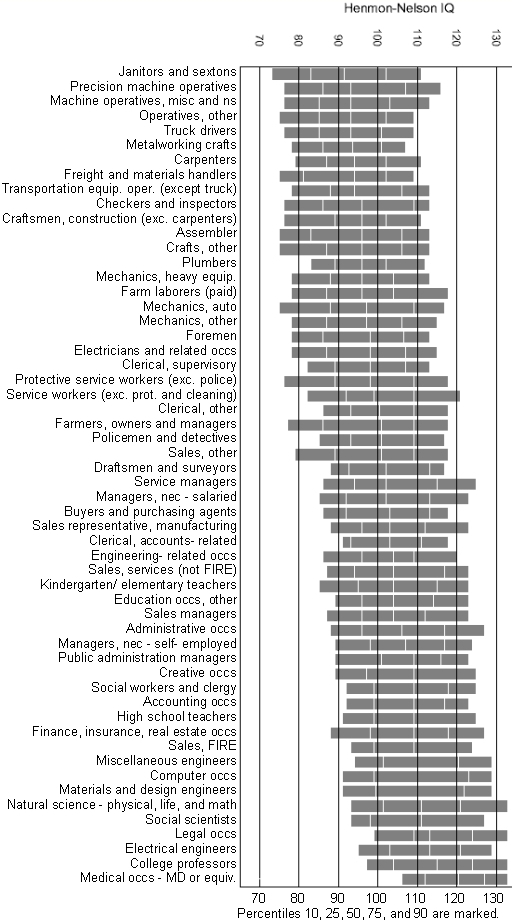
Right, but it's not a simple multiplication (AFAIK/IMO). The research suggests that ultimately practice dominates. I can't think right now as to how to cast that as an equation, but it has more non-linear terms. As to the IQ chart, I'm not convinced that that trend is statistically significant; even if it is, IQ is a pretty funny metric for 'innate talent' in most contexts.
There's also the issue of the nature and quality of the practice. I can work arbitrarily hard at something, but unless I'm targeting that effort effectively and using appropriate feedback mechanisms, it's entirely possible for me to accomplish literally nothing. How one acquires the ability to practice effectively is the meta-problem, and one which I'm still working on.
In the particular case of math proofs (which I think you're referring to) you have the additional issue that (I think - I'm not a mathematician) proofs often require intuitive leaps. This raises additional problems, because (if you're thinking in terms of acquired ability rather than talent) intuition is typically associated with high levels of expertise - e.g. in the Dreyfus model, you expect intuitive solutions from the highest two levels ('proficient' and 'expert') which you'd expect only a fairly small proportion of individuals to reach (incidentally, the Dreyfus model also suggests that you don't really want 'proficient' or especially 'expert' individuals teaching the lower levels ('novice', 'advanced beginner' and 'competent') precisely because of this qualitative difference in problem-solving style, which validates the construct inasmuch as it reflects your experience). In this scheme, intuition is (horribly simplified) superb pattern-matching, which is almost certainly not what your hard-working students will have been practicing (in my experience, stereotyped 'hard workers' focus on the mechanical aspects of a subject). Teaching intuition/pattern-matching is of course reallyhard.
> What benefit do you feel will be gained by improving education for everyone, as opposed to helping those at the top? I.e., why do you believe better educated plumbers will provide more benefit than better educated scientists, engineers, artists and business leaders?
Currently, where I live (UK), it's well accepted that there are massive differences between private and public education, as well as within the public education system. From what I've written, you can probably guess that I don't really hold with the idea of innate talent, and I don't believe that you can necessarily differentiate between 'future plumbers' and 'future [scientists|artists|etc]' until late adolescence or possibly even later. Combining that with the fact that I think that equality of opportunity is really important, I'm not really comfortable with significant investment in optimising for 'gifted' individuals until we've run out of ways to add resources to bringing up weaker parts of the education system.
It's really hard to predict how altering the balance of ability will affect both the average and the top end - will improving the high achievers pull everyone else up with them? Will raising the median motivate the high achievers to do even better? - so I'd rather support the strategy which has obvious direct social benefits (improve equality of opportunity) rather than one with the potential to maybe advance the leading edge a little faster.
I didn't mean to propose an exact multiplicative relationship. I merely used it to illustrate how the two claims
a) innate talent exists and is important
b) practice is also important
are not incompatible.
As for correlation between IQ and various professions, not to mention wages, there is plenty of statistically significant data on this. See for example [1], which shows excellent correlations between AFQT (the US Army's IQ-like test) scores and post-military wage (not to mention many specific objectively graded tasks within the armed forces).
(Note that IQ test-retest scores tend to be highly correlated - it's rare that a child scoring 1 stdev below the mean will later score 1 stdev above the mean.)
In the particular case of math proofs (which I think you're referring to) you have the additional issue that (I think - I'm not a mathematician) proofs often require intuitive leaps...Teaching intuition/pattern-matching is of course really hard.
True. But nevertheless, some students pick it up immediately while others never do. The question arises, why?
Also, as for what is "well accepted", there are lots of things in the field of education that are well accepted but false. For example, people widely believe that test prep significantly improves SAT scores [2]. They also believe school quality (rather than % of Asian students) explains many of the differences in test outcomes between US schools and Asian schools [3]. See also Bryan Caplan's book [4] which shows lots of evidence that most of what is done to children before age 18 has little effect on adult outcomes.
So if you have evidence that public schools and private schools significantly affect outcomes, go ahead and post it. But most of the evidence I've seen suggests school quality is dwarfed by non-school factors. People just ignore the evidence because they don't like the conclusion.
[1] Handbook of the economics of education, by Hanushek and Welch
While I accept that IQ has some statistically significant correlations with interesting things, and is stable within individuals, I don't think there is consensus as to what that actually means. But I might just need to read more. Actually, I always need to read more.
That aside, I think the core disagreement here is that (I think) we have both taken the same data (a lot of stuff surrounding 'hard work' and education is clearly utter rubbish) and taken it in two different directions: you've gone in a more innate-ability, behavioural-genetics direction (I think), while I'm more interested in things like the effect of practice. The nature-vs-nurture debate will probably outlive both of us, and there is evidence for both arguments.
Ultimately, I don't find innate stuff that interesting, because there is nothing I can do about it. I would rather focus on a minor factor that I can change than a major factor that I can't, and the research suggests that practice et al are far more than minor factors. So I focus on those. And until the debate is resolved, I will continue to espouse education policies which reflect that attitude.
Thanks for the references; a couple there that I hadn't seen before, and it's always worth reading stuff that disagrees with you.
That's nuts. My sisters and brothers and I out-performed everybody at our rural school, throughout our primary/secondary education. We were being brought up on a farm. There was zero practice and experience at academic subjects - we did chores, milked cows(!), made hay.
There HAS to be some nature-component to our successes (1 VP/Intel, 2 Directors at other tech companies, 2 researchers, 1 entrepreneur :)
Again, I'm not a psychologist, so this is only my (limited) interpretation of what I've read.
I'm not saying that there is no nature-component. But, (AFAIK) there is no real evidence for something that would correspond to some idea of 'Raw Smarts' that (a) has a meaningfully large effect compared to practice and experience, and (b) generalises.
What I've read suggests that, yes, there are a whole bunch of nature-components and nurture-components which initially serve to differentiate ability in young children. But the direct effects of these get quite rapidly dominated by the feedback loop of ability->motivation->practice->ability. So there's an initial differentiation - because of a subtle difference in brain chemistry, or earlier maturation, or better access to books, or competition with high-achieving siblings :); but in the longer term, there's a pretty consistent picture that excellence and ability at a high level is dominated by deliberate practice and sustained effort over time.
Of course, psychology research is hard to separate from its social context and underlying cultural assumptions, and it may just be that our egalitarian culture is uncomfortable with the idea of innate ability dominating, and steers research accordingly. Or I may just be missing the point entirely.
The essence of my point is that, as things currently stand, the research suggests that innate ability is not a significant component of ultimate achievement, and that we should therefore not predicate our approach to education upon the idea that it is dominant (which is what the comment I was replying to seemed to suggest).
That makes sense. There's nothing more common than the high-IQ underachiever.
We didn't have books (2 in the house, gifts from older cousins), but we were fairly competitive. And our folks told us "You guys are smart; you'll all go to college". So we did.
I went to college with people who had been raised according to the "praise hard work" theory (i.e. Asians), and it's got its own set of problems, I think.
You initial stab at college sounds strikingly like mine. After my ridiculously bad run through High School, I made the mistake of going straight on to college and bombed out within the first year.
It took me 3-4 years, working out in the world at crap jobs, to motivate me to go back. It's never too late to head back in. I worked full-time all through university and after 10 years earned up to my M.S. but I did it debt free, and getting promotions/better jobs as I slowly, agonizingly, climbed up the education ladder was a powerful motivator (I also met my wife in school, and made many great friends).
It can get rather political, but the general definition of giftedness is to be in the top 5% on a good, standardised test of cognitive ability, such as the WISC or WJ-III. If you were at the top of any representative group of just 20 children of the same age, you were clearly gifted. In some schemes, a smaller number qualify as highly, exceptionally then profoundly gifted.
It's worth nothing that there's no rule that someone can't be both gifted and dyslexic, for example.
I had two parents with post-graduate degrees, but your experience sounds quite a bit like mine. I waited until year four to really bomb in University (mainly due to painful shyness that had been dormant until that point). I stuck with it, but that was a really eye-opening experience.
I'd like to think the Internet has changed this to some extent. My guess is that I would have found it a godsend. I remember trying to learn advanced statistics and getting frustrated because all of the software was expensive. Nowadays you've got a huge amount of free software and even more importantly strong active communities around it. I am cautiously optimistic that this will help connect lonely smart kids to others in the world who share their interests.
You mention that you correct your sisters when they tell their children "you're smart"- but what would you do differently if you could get a chance to change things.
I venture that the 'not smart' and 'smart' kids both suffer from social anxiety & lack of motivation issues. Could some of your ideas be the ground for an educational startup?
> I can remember having conversations with my parents where I'd bring home a 90% in a test and I'd get asked "what about the other 10%?" I don't think this was asked in a way to be mean. In a strange way, I think it was a weird way of showing pride because all you can "complain" about is a missing 10%. Whatever the case and in spite of well-meaning intentions, the message that was hammered in was that nothing ever seemed good enough.
THIS attitude has scarred me for life. Even if I came first in the exams, first in coursework, and got 90%, my parents would be disappointed in my failure to get the other 10%, which'd frequently result in beatings or expulsions from the household.
As a result, I now work myself to the bone, constantly abuse myself mentally, and can never get a sense of satisfaction or achievement from anything I do, as I've been trained to believe that everything I do is worthless.
Sorry to hear that. The ridiculous pressures placed on gifted kids in this regard is widespread and, IMO, not healthy for society as a whole. But usually doesn't involve beatings. However, it is possible to undo the damage. I walked away from a national merit scholarship and dropped out of college to go find out who I was other than an obnoxious brainiac. I wish I had some words of wisdom to help you. No advice comes to mind (but then I don't typically do advice anyway).
Consider this a cyberhug and meant in the best way possible. If you aren't the huggie type, then a cyberbow if that works better.


I grew up in three small towns. For the first 9 years, in a town of less than 1,000 where the 3rd and 4th grades (for example) were in the same class.
When I was 8 I was doing the same work as the 7th graders without any real trouble. It's all this small school could really do for me. This was actually mostly OK. Sure I was largely around (much) older kids but it really wasn't as isolating as some other experiences posted here.
Next was a slightly larger town (5-10,000) for 4 years. In the 4th grade my spelling tested at the 10th grade+ (I ran out of "test"). In the 5th grade I was doing algebra and trigonometry. By the 7th grade I was doing calculus. Honestly, maths was really the only thing that interested me. Until that is my family got a computer we couldn't really afford (a VIC 20), which turned out to be fairly limited (much less so than the C64 that came after it).
I can distinctly remember at age 10 reasoning out that God didn't exist (I was raised Catholic and went to a Catholic primary school with nuns and everything).
It's in this period where I think it became first apparent just how socially well-adjusted I wasn't. I think it's fair to say I didn't particularly know how to relate to others. Honestly, I'm not sure that still isn't true.
By 9 or so I could beat anyone I knew at Chess. Actually I think this was true at 7-8. Not that I knew anyone particularly good (not even remotely). Attempts to find a challenge from, say, chess AIs were pointless. They were pretty weak back then and tended to be defeated by going "off book".
Then came a move to a mining community of ~15-20,000, which I basically hated for the 5 years that constituted high school. The awkwardness and isolation from primary (elementary) school was compounded. It's always seemed to be that when it comes to social interactions and relationships, I somehow "missed out" on the instruction manual, or at least the training wheels, and the people around me were always speaking some language I just never understood.
I understood numbers and computers.
One of the problems was that I was bored. I found school so insanely easy. Nothing was really a challenge. I'd get told how smart I was. Only many years later did I fully appreciate just how much damage it does to be told you're smart. It demotivates you and isolates you.
I would fail assignments and classes because I didn't do them. Not because I couldn't do something but something was never good enough. Or I'd fear the embarrassment and "humiliation" of not knowing something and having that pointed out to me.
I can remember having conversations with my parents where I'd bring home a 90% in a test and I'd get asked "what about the other 10%?" I don't think this was asked in a way to be mean. In a strange way, I think it was a weird way of showing pride because all you can "complain" about is a missing 10%. Whatever the case and in spite of well-meaning intentions, the message that was hammered in was that nothing ever seemed good enough.
My father was a fitter and turner in the British merchant navy. His father and grandfather were likewise tradesmen. My mother dropped out of high school (although her father was a school teacher and principal for much of his life).
Basically I don't think they knew what to do with me. Academic pursuits weren't something they were equipped to deal with. My two sisters were cut from the same cloth, neither being remotely academic and neither finishing high school.
I took notes in class but never looked at them again. Either I didn't need to (particularly for maths) or I didn't care to (eg human biology). I never really learned how to study. I can remember scoring 85% in multiple choice exams for subjects I knew nothing about just by figuring out the skills to pass such exams.
So after finally finishing high school I went to university.
It may sound strange but I don't think it ever occurred to me in high school that I might do computer programming for a living. It's not like thought about it and either wanted to or didn't. I never even pondered the question.
I ended up applying to do a science/engineering double degree because it looked hard. A bunch of other people in my class also ended up applying for engineering because they didn't know what to do either but, as I learned years later, I seemed (to them) to know what I was doing. I have to wonder what they would've become had I gone to school elsewhere.
Whereas high school was structured, university was not. Nobody checked your attendance. Painful shyness quickly caused me to avoid going to lectures altogether. I was completely unequipped for university.
I barely skated through first year and bombed out in second year (when you actually had to work). Some years later, work finally cured me of many of the aspects of painful shyness (eg standing up in front of people and giving presentations).
At one point my parents thought to send me to boarding school (in a 1 million+ city). I fought this and deeply regret it. It was an unknown. I wonder how much better I could've done if I'd been put in an environment where academic excellence wasn't a recipe for instantly being ostracized (as it was in my shitty state high school).
Likewise I wish I'd stuck with university long enough to find some guidance and mentoring. All in all it feels like I drifted through the system and eventually fell through the cracks.
At no point did I ever really find people like me either. Through primary and high school, the towns seemed too small for that. The university had a computer club but I found that lot, as a whole, to be a pretentious lot with whom I had precious little in common. It seemed like university just had a different cookie-cutter mold for the "in" group.
Largely I was left alone (something I realize I quite clearly contributed to). To me though that seemed to be an improvement from high school so I just went with it.
Now my sisters both have children and I see them both laud their children by telling them "you're so smart". I try to tell them how damaging this is and they shouldn't but they just don't get it. Old habits kick in.
I envy those people who grew up in households where at least one parent had gotten a college degree (a friend I later made had a PhD in lithography stuff, 3 members of his immediate family had PhDs and a great uncle or something won the Nobel Prize for Physics a number of years ago).
I really don't have a solution here other than to hammer in the point: stop telling children they're smart. I don't think I'm any kind of genius but it certainly did me absolutely no good at all.