Thanks for the comment. That makes sense, since as you are saying, a base10 number can be expressed as a polynomial where x=10. Eg: 983 = 9x^2 + 8x + 3 aka [9, 8, 3]. Wondering how big the number has to be to make sense, and where this is used in practice.
FFT is used extensively in curve based zero-knowledge cryptography, not for the purpose of splitting a single large number into smaller ones, but to interpolate and evaluate very large polynomials (for example of the degree 2^27).
All of this happens in a field of an elliptic curve so the complexity reduction is greatly appreciated.
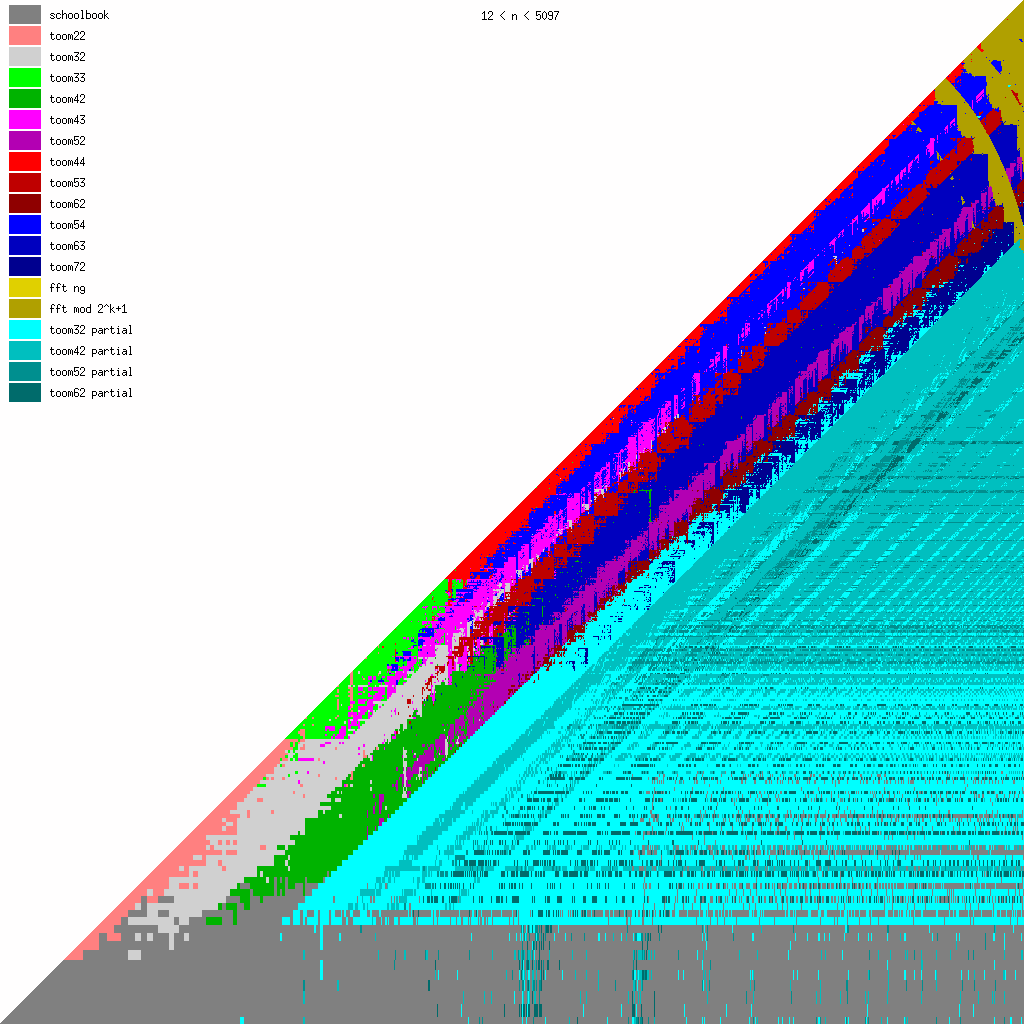
GMP has lots of other methods in between schoolbook multiplication and FFT multiplication. A nice one is Karatsuba multiplication which is very easy to understand and delivers O(n^1.58) rather than O(n^2) performance. Python uses this method for multiplying large numbers together
PS: if you're interested in multiplying "ludicrously large numbers", Harvey and van der Hoeven had a nice breakthrough and got multiplication down to "FFT speed" (n*log(n)), see