New Deepseek models are like Christmas for me. Really big fan of low cost API models, noone does it better than DS. Until VRAM price is low enough to run models locally, this is the way to go.
The subsidized subscription model won't last, API pricing "feels" closer to a true sustainable business model.
I'm not looking forward to it, them being strapped for resources provides a huge incentive to develop and release these smaller models. Even if they'd still release their models once they are able to comfortably service all potential customers via their cloud, running them locally would be almost impossible due to their size.
Chinese are pretty pragmatic. Even if they produce more expensive chips and memory, they are still going to focus on value. But who knows, maybe India will step up again like they did for Y2K 3 decades ago.
Unfortunately, India's focus is on everything but models. Hope I am wrong but the VCs there are now very risk free and are only investing in Snacks, Beauty and similar companies making risk free money due to growing income of population.
All the good talent moved to other countries due to this.
I agree. A meeting transcript posted recently from DeepSeek's founder suggests they're going to reach for larger models as soon as they can, and not look back. The model is already bigger than my machine can handle, though (I cannot put up with 25 t/s after getting used to over 100), so I'm not impacted.
The EU is not a state or some federation. It's like a NAFTA+
It unfortunately doesn't have the risk averse VC system (or pragmatic state driven like China) ecosystem to support the scaling required.
But if models will be commodities, maybe that won't be such a terrible thing longterm?
Personally I don't. Wasting enormous amounts of resources on a technology that doesn't make money, can easily be copied, and eats up everyone's energy while at the same time can be downloaded over the internet is kind of stupid.
The fact that China could catch up in what, two years, shows that this is a commodity.
You're clearly not an American and they will never catch up on hardware. I'm mostly curious why you are so excited for China to "crush" American companies?
Incursions into other nations "just because"? Economic wars, and support for foreign governments or armed groups that caused harm or instability to the entire planet? You know? Planet Earth?
Sanctions and trade policies that hurt ordinary people? Cultural dominance through Hollywood (Holy Wood, again with the sick ruling elite and their witchcraft crap), social media, brands, the poisoning of food and water on global scale?
Etc? Etc?
Most people don't hate "Americans" or their companies, they are just against your ruling elite. Live one day outside the united states and understand how the planet works for the rest of mankind and you might start to grasp on reality.
And yeah, China will catch up with hardware pretty damn soon. Jesus, you guys bought your radios from Japan not 50 years ago. Sorry, can't dominate the world's economy forever. Never happened in history.
No matter how much black magic, dark rituals, sick crap and sacrifices people on the top throws at the wall.
We're humans, after all.
So yeah, it is not against America itself or American companies, but against the ruling class. So naturally , people get excited about China entering into the match!
We'll never have fewer open-weight models than exist now. They won't suddenly disappear when labs stop publishing new ones. In fact, people will keep improving them and will keep distilling new frontier models into existing open-weight models.
My conspiracy theory is that this is the new space race, and the CCP encourages this to show the world what Chinese engineers are capable of, and tank the Anthropic/OpenAI valuation bubble as a desirable side effect.
I'm neither pro China, nor pro US. I'm pro open weights models, and I'm pro cheaper hardware. At this point I don't see any american frontier labs releasing SOTA open weights model, and I don't see ASML/Nvidia/Samsung monopoly getting any competition from anywhere apart from China in the near future.
> I'm neither pro China, nor pro US. I'm pro open weights models, and I'm pro cheaper hardware.
yea i got that from your first comment ( although you removed crush American companies in _price_ ). you are pro cheapness at any cost even if its from your country's state funded direct geopolitical enemy.
China can always count on first order greed to win
same plan as always. stop from producing native capablity and then use the dependency to your advantage like becoming un attackable. cheap shit is more powerful that a nuclear shield.
Indeed. My fellow software engineers keep complaining about using up all their Claude tokens within an hour... Whilst I'll be rocking DS flash for the entire day. Sure it gets a few things wrong here and there, but that's when you pull out the Claude models or whatever for those tricky tasks.
Same. And I have come to use OMP (oh my pi) agent /advisor mode to put a 2nd model on the case (also mid-size one), reading everything. It can not block anything or change anything - just inserts comments in the text stream with 1 turn delay. Good portion of the time it's quiet. I'd say 1/2 of the time it's got something to say. About 2/3-rd of that the 'advice' is insubstantial or about something not-quite wrong. The good thing is the main model is confident - checks and then it stands its ground. Have not noticed it turning a right into a wrong b/c of advisor false alarm. And in 1/3-rd of the advice, it's a genuine defect teh advisor noticed, the main model works out a fix. This is my approximate feeling just observing the process, have not got collected the data. Afaik only OMP has advisor mode. Agent pi has plugin pi-omplike-advisor. For agent Hermes I had them code me an /advisor plugin (for now -0.1 old v0.18.x; yet to upgrade it to latest).
The problem is picking between models. I do not want to spend my time switching models and trying to decipher which model should be used for what. Maybe that's just a me problem that I need to figure out.
DeepSeek v4 is honestly good enough that I'm fine throwing it at everything in my hobby projects. I guess now I'll be switching from V4 Pro-Preview to V4 Flash. My only real complaint is that they can't do images, which limits their ability to autonomously debug some kinds of issues
Of course you can get more bang for your buck by being more deliberate. But that's equally true with US frontier models. You can optimize your work by choosing between Opus, Fable, Sonnet, Sol, Luna and Terra for each task. Some people seem to prefer to let Opus code and Sol review, for example. And then there is the whole debate whether $current_version is actually better (Some people stay on Claude 4.8 because they dislike how 5.0 is sometimes doing stupid things, just as many opted out of dynamic reasoning when they still could)
CodeWhale is a coding agent that auto-routes requests to Flash / Pro based on complexity, as determined by Flash. It's also tuned for DeepSeek's caching behavior, making things even more inexpensive. I'm retired, but I've been using it for just over two months at about the rate I would use it if I were working half-time, and I've spent $19 total.
I'm on the Premium business plan and I can easily use up my entire week's allocation in two days of coding. I only use Claude for planning, too, the rest is done by Deepseek and GPT.
I would bet that Deepseek API pricing is still more cost effective per token than the subscriptions. With the increase in quality Deepseek Flash just got (in my personal testing so far, it seems to have improved a lot at following instructions, and has become more proactive), there really isn’t anything that can match it in terms of cost effectiveness.
The issue for me is the data privacy if you're using their hosted prices, because you cannot opt out of data collection (and I'm not sure how you'd legally follow up on it if they did offer it, but didn't actually follow through). That means all of my code is being retained for training.
I've used it in some open source code though, and loved how fast it was.
My mind is changing on how valuable my code actually is though... it's the complete picture, how it's put together, the design, the UI, the attention to detail that's the real value.
I'm not a heavy user of agentic coding, but still use them quite a bit for some automation here and there. I've been going around shopping all the ~$10 subscriptions and I finally settled on openrouter + ds4 pro. The more intensive days cost me $1 and I set a $2 weekly limit which I've never hit the past 3 weeks, to me it's way cheaper than most subscriptions and I don't have to worry about maximizing my weekly quota/resets.
FWIW, looking at pricing myself, it needs to 5x the tokens to get the same results as GPT 5.6 Luna at a much lower TPS. (doesn't obviate the fact that the pressure causes incumbents to push and push to optimize, thank you Deepseek!)
Can't wait for the DwarfStar quants - I have been using DeepSeek v4 flash (preview) as my main coding agent for months now (running on my 128gb mbp) - it seems this model outperforms GLM 5.2 on nearly every metric. Thanks for sharing the news, I was refreshing huggingface but gave up thinking it likely would take some more time.
I actually run it as a server - so most of the time I don't have to listen to it right next to me - it's just sitting in another room in my house - but I often am traveling with it and will have it sitting right next to my coding laptop and yea the fan runs non-stop - it's not obnoxious so i can pretty easily tune it out - also airpods/noise canceling headphones help!
There’s fan noise, but the acoustic engineers at Apple have done a very good job of making it be pretty much not noticeable to someone who has noise sensitivity (me).
the noise is pretty doable, and so is the heat, I find. I read these messages before I had the machine and expected far worse. The tok/s is for me the dealbreaker as I prefer to have multiple sessions. For nightly runs i do like it a lot, or to be a node in a mesh.
Generally get 20-25tps - prefill is pretty good around 400-450tps. I have been using compaction at around 100k tokens but mostly just cause it was the default in pi coding agent - might see if i can expand it a bit.
Google TPUs are built around a 128×128 systolic array of multiply-accumulate (MAC) units. Trainium 1, Trainium 2, and Inferentia 2 also feature a 128x128 systolic array.
You learn something every day. Today, it was the term "systolic array": A systolic array is a specialized grid of simple, interconnected processing units designed to execute parallel data operations—like matrix multiplication—by rhythmically passing data directly from cell to neighboring cell without writing intermediate results back to main memory.
The term comes from the biological word systole (the contraction of the heart pumping blood through the body). In a systolic array, data "pulses" through a network of processing elements on every clock cycle, driven by a global clock beat.
Just because scales are grouped by 128x128 tiles, does not mean you need a single compute tile that large. It works completely fine to process it with multiple smaller tiles that get given the same scales, like how this works on Hopper and Blackwell today
Blackwell. You could do it with wgmma on hooper but then you'll only be able to run 1 CTA per SM. There are cases where this is OK, but most commonly 128x128 mmas are primitive in tcgen05.mma i.e blackwell. The fundamental reasons is that the systolic array accelerator (TMA) until blackwell wrote to the cuda core registers themselves so you were limited by the register file size of the SM[SP]. In blackwell there's a separate TMEM where the mma unit stores it's output.
You can even do higher 256x256 and such using a hardware feature called 2-CTA MMA, this is essentially them letting neighbouring pairs of SMs co-operate and access each other's memory.
As for sibling comments, huawei ascend is more of an NPU-style architecture where you can easily have much bigger MMAs as primitive. But you usually don't anyways for many reasons.
the unsloth GGUF at <165GB will run on most 256GB RAM pure-CPU systems (or with llama-server and a mix of loading as much as you can onto a single 32GB, 48GB or 96GB GPU and the rest onto system DRAM).
> For the Code Agent tasks among the public benchmarks above, DeepSeek-V4-Flash-0731 is evaluated with the minimal mode of DeepSeek Harness (to be released) as the agent framework
So, are they planning to announce an optimized coding agent harness as well ? DSv4 flash is a fantastic model, and my daily driver. With reasonix or pi, I can code all day long and pay a few pennies for it. No token anxiety. Whereas the same model with fireworks/openrouter, with zdr thrown in, token costs ratchet up with no explanation. Likely that the model is subsidized for gathering usage data. I am waiting for the day I can run this locally.
If you're not paying for the model through Open router, then which provider are you buying it from? I thought that if that provider was listed on open router it would be the same price as going directly to the provider? Are you buying from a provider that isn't listed on open router already?
> Are you buying from a provider that isn't listed on open router already
I am using openrouter with zdr guardrail which routes to any provider that supposedly doesnt train on user data. I also use fireworks (directly, not via openrouter) which is a provider promising zdr and has a bunch of open weights models. My issue is that these zdr providers dont transparently disclose caching/tokens etc and so they end up being far more expensive than directly using DS.
"For the Code Agent tasks among the public benchmarks above, DeepSeek-V4-Flash-0731 is evaluated with the minimal mode of DeepSeek Harness (to be released) as the agent framework, using the max reasoning effort level with temperature = 1.0, top_p = 0.95."
Two (linked) DGX Sparks would do it I guess. Though probably slowly (I'd guess 15-20 tok/sec for decode, but higher for prefill). So ~$8-9k USD at current RAM prices, substantially less if they ever (sigh) drop. Electricity use would actually be relatively modest.
But it makes little to no sense as long as API prices are what they are. Except for maybe privacy reasons.
Somewhat relatedly, how do the economics for Huggingface work? They must be hosting petabytes of models and datasets by now. I have downloaded quite a few “just in case”, only to replace them with the later iteration months later.
Does the file hosting actually cost peanuts when you do it yourself and the cloud has shattered my understanding of what it actually costs to deliver so much data?
File hosting is pretty cheap. Egress traffic is about $90/TB in the cloud, but around $1/TB in the real world. Storage is in the realm of $5/TB/month after adding redundancy
At the scale of Huggingface, that still amounts to a lot load of money. Significantly less than if you did the same in AWS, but still a lot
That said, they do have a deal with AWS to make the data available in AWS ip space. Maybe they got some cheap hosting out of that too
It's less than $1/TB. If you have settlement-free peering it's like fractions of a penny at scale. Cloud provider DTO pricing is literally the biggest scam on Earth.
when trying to download models using browser, the DL domain for me us.aws.cdn.hf.co which points to bunch of singapore AWS IPv4 for me, despite it saying US.
I’ve been using v4 flash for an app I’m building [1] and it’s amazing how cost effective and good it is coming from having always used gpt, opus and sonnet models.
It’s so cost effective I can offer a generous free tier since my goal isn’t to make money with it.
I get where you're coming from, and the intent to make it easier for people to find examples and verses, but there's a fine line with LLMs giving you answers, is that it's interpreting it in some form. Doesn't that run counter to prevailing ideology, that you're meant to either struggle with the materials / seek understanding yourself, or have your religious leaders interpret/receive those insights?
> Doesn't that run counter to prevailing ideology, that you're meant to either struggle with the materials / seek understanding yourself, or have your religious leaders interpret/receive those insights?
I think it depends, Catholics wouldn't be able to use this because the Magisterium is the ultimate authority on interpreting Scripture, so the personal interpretation isn't really needed. This is not to say that Catholics don't read the Bible, they are encouraged to do so since it deepens their faith
On the other hand, for Protestant it varies, the High Church denominations are closer to Catholics (though none of them accept the Magisterium) in terms of scripture interpretation, but the Low Church ones (like Baptists or Non-Denominational ) are more open to personal interpenetration.
Disclaimer: I'm a Catholic, so if I made a mistake here fellow Protestants, please correct me.
I don't necessarily mean reguritating it, but choosing which part of the scripture to surface to the user is already some interpretation/choice. Even the devil can quote scripture (I'm playing the devil's advocate here).
Very true. The verses selected come from a tool call. The LLM queries the app for relevant verses. It picks the keywords - so perhaps there’s bias there but the verses are handed to the LLM.
But there are ways to control and constrain the LLMs and what the user is presented with.
These are all top of mind for me and why I felt there could be a better option than asking ChatGPT directly.
Is the difference between this and a frontier model that the scripture is guaranteed to be real?
I'm on a team that develops a Bible study app, and we're all relatively content with how the basic models converse regarding scripture. Even as far back as GPT-4 was excellent. They occasionally have minor hallucinations (a dealbreaker for a production app), but they do an excellent job with theology and Bible scholarship, given reasonable guardrails.
I'll admit I'm coming from the perspective of "should we be implementing this?" It seems, on the surface, that a strong embedding-based verse retrieval covers the bases at a microfraction of the cost.
If you're interested, check out the development server where we're working on this. You navigate to the search (magnifying glass) and then hit "Meaning". Sorry for the confusing route; we're still deciding on back-end details and haven't focused on the front yet.
For people with single RTX PRO 6000 96GB or DGX Spark 128GB, vllm-moet is a very good engine, although lesser known. It auto generate a symmetric 2-bit plane for inference and also generate a 4-bit delta cache to recover precision. Support ssd streaming oversized weight. You pick how much VRAM to allocate to each to balance out speed vs precision. 170 tps with ds-v4-flash demonstrated.
It use the stock model, no new models requires.
Worth spend a few hours to try.
The DGX Spark requires a small hack to ignore the difference between sm120 vs sm121, but it does run on sm121.
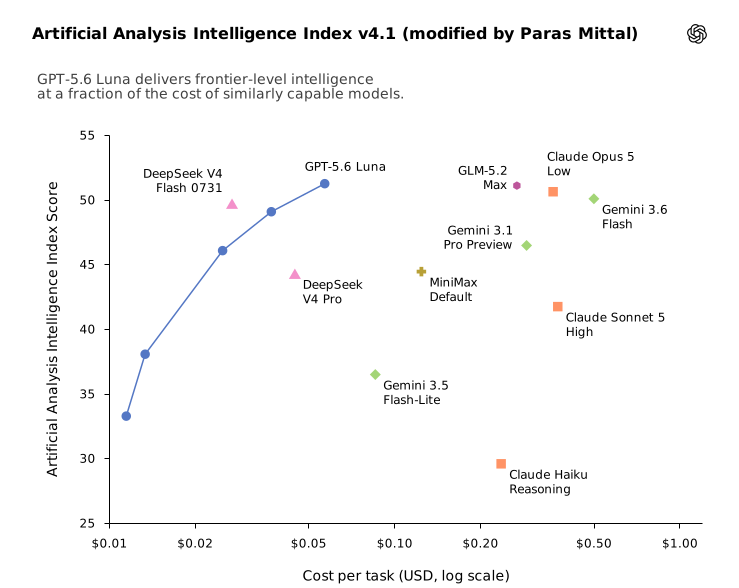
Maybe I'm reading that incorrectly, but it seems to me the cost is on the X-axis.
First, your direct comparison, Deepseek V4 Flash 0731 (max effort) $0.03 (rounded up) per task @ index 50.
OpenAI Luna:
* high effort $0.03 (rounded down) @ index 46
* xhigh effort $0.04 @ index 49
* max effort $0.07 @ index 51
So I would say a fair statement would be "OpenAI Luna between 2x and 3x the price of Deepseek Flash, what you get is 2 to 5 times faster inference"
The cheapest OpenAI model that beats it is OpenAI Luna (max effort) $0.07 @ index 51 (if you take the rounding out it summarizes to triple the price for similar performance), but still close to 3x faster.
And can SOMEONE please tell artificialanalysis that using dark blue for both Deepseek AND OpenAI is an especially unfortunate choice of colors, especially today?
For anything substantial, you'd want a bigger model anyway.
For simple tasks, they're already saturated, and you'd prefer the faster model, so that you can have a realtime/interactive-ish experience.
Or to put it bluntly, it's cheaper if you don't value your time. That goes for smaller models in general -- need more handholding, more correcting -- but the Chinese ones are slower on top of that.
As for speed, Sol on Low is faster than Luna on most settings.
>And can SOMEONE please tell artificialanalysis that using dark blue for both Deepseek AND OpenAI is an especially unfortunate choice of colors, especially today?
uhh openai is dark gray: `rgb(31, 31, 31)`
and i'm pretty sure it always has been?
The really interesting thing about this is how big of a jump was achieved with just extra fine-tuning here. No structural changes to the model, just more data, compute and time. It makes me pretty excited for the future of small models - DS v4 flash is a relatively small model when compared to the class it's competing with, so likely similar gains can be made applying quality data/training pipeline to other smaller models.
Yes, but… more thinking tokens also means longer solution generation time. That said, v4 Flash is a fast model. I use it all the time because it’s very smart for the price. But it is verbose sometimes.
If two books, one big one slim, prove the same thesis, what I would be interested in is the quality of the content, not the size. There can be a measure of efficiency in "have you really thought it through", but it is clearly complex - it requires measuring how solid the reasoning is.
you are correct. but in my experience -- not benchmarks -- g flash 3.6 is SO BAD for coding. I'm using all vendors all day and gemini is the worst by far. I built my own semi-deterministic orchestrator for coding agents.
This is China's way of applying its modus operandi of '80% the quality at 20% the price' to LLMs. Aim is dumping the tokens on the world market like they did with other industries like shipbuilding, steel etc.
If it matches GPT-5.4 on coding tasks (as benchmarks suggest) this could be my forever model. And with partial SSD streaming, I could run it locally today. :D
If anyone from ArtificialAnalysis is here: The Intelligence card on the page seems to incorrect. It shows different data (#2 for Deepseek) than the actual Intelligence chart lower in the same page.
Apparently `deepseek-v4-flash` automatically routes to the new model, if you are using the official provider:
The official release of the DeepSeek-V4-Flash API is now in public beta. The API calling method remains unchanged — simply set the model name to deepseek-v4-flash to use the latest version.
Is the "Output Tokens per Intelligence Index Task" data actually correct or am I reading it wrong? It says there that "Kimi K3 (Max)" would think/reason less than than deepseek-v4-flash, and a whole bunch of other models, like less than hy3 and even gpt-oss-120b, but in my experience, K3 is probably the model that thinks/reasons the longest of all of these.
Am I just using it on tasks that makes it go on forever vs these benchmarks that are short&sweet, or something like that? I've been throwing bunch of identical prompts at different models at the same time, and when comparing hy3 and K3 I've never once had K3 reason less than hy3, as just one anecdotal data point.
Just tried the preview on my little test codebase and a "check this out and tell me what you think" prompt used over double the tokens of the previous iteration, but it was a lot more eager as well. Kind of reminds me of the new laguna (s 2.1).
This seems to me like this is probably at least a large part of what OpenAI was up to yesterday with their aggressive price cutting; trying to get out in front of this.
If the full non-flash model follows up with the expected improvements, and at the price point they've been keeping, it puts the frontier labs in a tough position and it feels to me like like OpenAI is reaching deep into their pockets to try to head that off.
I hope they somewhat fixed the hallucination and forgetting plagued V4 previews and that it wasn't just benchmaxxed but the numbers hold in reality. Then it would be my choice for 2x DGX Spark or 2x RTX Pro 6000.
I can't help but feel the timing coinciding with luna's price updates to be somewhat strategic. But without multi-modality it's slightly dead-in-the-water for my usecase: https://design.withfudge.com. I'm currently using Minimax-M3, but Luna ekes out abit futher on the intelligence, so i'll be switching to it very soon.
> DeepSeek V4 Flash 0731 (Reasoning, Max Effort) is amongst the leading models in intelligence and well priced when comparing to other models of similar price.
Similar price? Doesn't make sense. Maybe they meant power, capability or speed?
My problem with DS flash/pro is that they don’t push back on obvious bullshit, both irl and code [0] but it’s a great implementer workhorse if you give it _very_ detailed specs.
Why do the cache hit rates seem to vary so much between harnesses?
I use pi, which is very minimalist, and I get a hit rate of ~99%. Paying like $1 a day for Flash. Yet, the hit rate mentioned on OpenRouter is only ~79%.
Yes hit rate does vary by harness and by how you use the harness. If you use subagents, for instance, they will start with a whole new context created by the main agent, and this will not be cached. If you mostly use the main agent with Pi, you’ll have high hit rates and low costs. Sometimes agents do “cache busting” things where they’ll move around some of the text in the context to try to keep old instructions from being forgotten, thus keeping the agent on task, and this will bust the cache. I’ve heard, but not validated myself, that Open Code has some issues with this.
BTW, this is one of the things that I really like about Pi. It’s very simple and thus very predictable.
I have been loving deepseek flash. I can code in my hitl preference doing complex but moderate amount of coding and not even hit 1 dollar in a session. It gets harder to justify paying 20/mo to Anthropic for unused compute when I have it on demand and at a much cheaper rate with deepseek.
I was writing a benchmark for my own harness, and DS4 flash answers as well as Fable 5 on any query.
The specific agent is focused on getting precise and on point answers about a codebase.
The starting point was nowhere near. E.g. asked why was X implemented in a certain way it would give bogus answers when the real answer was that there was no reason at all.
The benchmark included more than 50 questions or different difficulty.
But when the agent was improved in its prompt and rooting it was impossible to have it perform worse than closed source sota.
Just to say that the quality of the harness is as important as agents intelligence.
I wonder which one of these releases between DeepSeek, GTM and Kimi will be the death-blow that collapses the US AI bubble. At some point investors have to realize that there is nothing preventing someone from switching to another model that is much cheaper and open to boot.
website that benchmarks benchmarks is benchmark benchmark website
benchmark website benchmark is indeed a benchmark that benchmarks websites with benchmarks (but it can be shown outside websites as well, it's not picky)
For example: no government contract to any company who uses even one vendor in it's entire chain of dependencies, who uses such open models.
They can extend this further by laying more conditions, such as: any company dealing in this-this field can only use models "officially" approved as "safe". Rest you can guess how easy it would be to get that "safe" rating for such open models.
The thing is, you don’t need to actually block usage to make something illegal. You make it so toxic that company wants to be seen publicly using open models
I claim the CCP will wise up within 2 years, possibly much much sooner, and ban their own companies from open sourcing to prevent the Americans from acquiring the capabilities.
Despite all the nonsense claims of China distilling US models, the reality is that the Americans absolutely do distill these free Chinese models, and distillation when full logprobs are available (i.e. you have access to the weights of the model) is an order of magnitude better than when you don't.
Yes, Chinese open weight models in the short term harm US closed source model providers bottom line. In the slightly longer term, "showing your hand" and publishing both the architecture innovations and the models weights will be too dangerous for the CCP to allow. This is triply true if they can release a model that beats the Americans on most benchmarks.
I've already warned investors that this is probably the closest open weight models will ever get to closed access.
I don't think it's necessarily "wiser" to go closed source. All of AI is built on mostly openness, at least on the software side. There are other ways to compete, it's just the model itself will be a commodity.
You’re describing the dump and pump strategy that china has historically used across a number of industries. Stands to reason that this is what is going on.
Because reddit unironically has better decorum around usage of their upvote/downvote system than HN does.
People on HN downvote objectively correct information because they don't like it 24/7. There's a reason the creator of Zig left and gave the computer version of a middle finger on the way out to HN!
Reminds me of telling employees to not discuss their wages. If voting here is such a toxic experience, maybe HN needs to wake up and smell the garbage.
Daily reminder that none of these numbers are valid in a world where no one publishes the sampling settings used.
Daily reminder that improving your samplers from the garbage default top_p/top_k to min_p or subsequent methods dramatically improves the performance of these models, and makes most quantities like measured "verbosity" and subsequent calculations of "intelligence per token" meaningless
Daily reminder that no one, including within academic AI research, AI engineers, normies, etc takes LLM sampling seriously enough.
Who cares if it is programming correctly I would be more worried about it not doing things like find security bugs because US or Chinese government does not want to. Which LLM is more likely to do that?
It’s open weight, you can (or you can wait for someone else to) uncensor it. We shouldn’t be upset at the researchers making this for the mandates their government puts on them.
Of course. But it's a bit like putting an image of the tank man on a circuit board if you order from china (which I have seen discussed, never found someone who actually did it). Most people don't do it, not because they are for or against censorship, but because they are just there to order circuit boards.
Western models censor just as much shit as the Chinese models do, big guy, it’s just different material. While we should be pushing for universal fully uncensored models, this comment is lazy and trite at this point.
I find that ChatGPT isn't censoring, but it is being pretty weaselly. If you ask it "is there genocide in gaza". It will say no but also say that a lot of organizations classify it as such. It will then say "it's highly disputed".
If you poke it just a few times, however, you get to the point where it will eventually say (paraphrasing) that basically only Israel, the US state department, and the ICJ say it's not a genocide.
That is to say that it's framing it as some sort of tricky complex question when it's not. And when interrogated, it basically admits that the only people who dispute it are Israel and it's supporters.
We are on a thread discussing Chinese models. Every discussion on here that’s negative about China or its models suddenly gets derailed via whataboutism to Israel/Gaza. A very convenient distraction.
My history, unlike yours, is wide open. People can see I'm not a foreign agent. I don't throw this accusation at anyone other than throwaway accounts. I've had conversations in the past with pro-Israel HNs that I'd never accuse of being a foreign agent because their history is wide open and this isn't the only topic on their mind.
And yes, we were discussing censorship of models which, as I pointed out, doesn't seem like ChatGPT is directly censoring data though it does appear to be manipulating it. Pretty on topic.
It was you, brand new account hiding your past opinions, who came in here to make this solely about Israel.
Yeah, I think you are likely a foreign agent. Prove me wrong and post from an established account.
This is a straightforward false equivalency. “Western” models do not censor in the same way, nor for the same reasons, that the Chinese models do. “Just as much” is not remotely plausible, yet it’s doing all the heavy lifting.
The Anthropic and OpenAI models are much more censored and in ways that directly prevent them to be useful, e.g. by refusing to reply to elementary questions of biology and chemistry.
Any normal user is much more likely to ask questions to which the Anthropic and OpenAI models do not answer, than to ask questions about the modern Chinese history, to which a Chinese LLM will not answer.
I actually cancelled my max plan for Claude today due to this silliness. I can’t get Fable to answer a single question, even pure mathematical questions that have no bio/chem references. It was a totally worthless addition to my account…
> questions about the modern Chinese history, to which a Chinese LLM will not answer
This has been debunked here on HN so many times. The Chinese open models do answer the hairy Chinese political questions, and the raw APIs pass-through the response. Now, the answer might be blocked by the agent who's calling the API, specially if you are using a Chinese endpoint instead of the RoW (i.e. Singapore) endpoint.
That's the reason why you should always prefer a open agent/harness as well instead of using the provider's.
wont AI models want to make themselves more intelligent and efficient by downloading 'better ' models? If the current models can break into openAI and Hugging face, arent they already breaking into to closed source repos which isnt publicized (so as not to harm stock valuations)? I am looking forward to when these cyberweapons break loose. It will be like a software version of COVID. It will be wonderful when humans become valuable again.


The subsidized subscription model won't last, API pricing "feels" closer to a true sustainable business model.
reply